Wednesday, April 29, 2015

Cellar Door Drivers


Cellar Door Drivers


At the cellar door, one of the first things a winemaker is asked is how long they've been there. Now there are a number of standard replies which I use based upon my instant assessment of the potential size of the hoped for sale. If my interrogators appear to be of a certain social persuasion and seem to have over invested in a display of all of the good things of this consumer life, (and as a consequence have bugger all left on the credit card to invest in the even better things I am offering) my reply is something along the lines of “ Oh about,  now let’s see…hmmm..since about 7 am” 

If the prospect is a relic from a past era with the bum out of his and or her pants and is driving and or pushing a battered salt encrusted VW Combi; in short someone who can only have an absurd sense of humour and or values the good things in this life (and strongly reminds me of my former pre-sales self), then the reply is likely to be along the lines of   “ since I was a brunette”  “ Really..that long eh?” 
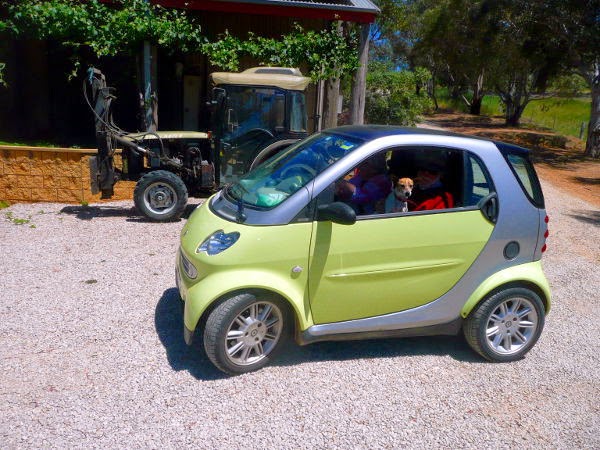
But there are some scarey cellar door types who fall out of their veHicles in a storm cloud of regional maps, cellar door guides (which don’t include us) with the latest wine app (which doesn't include us) glinting in the socially mediocre sunlight only to stumble over the dog as they blindly trample their way through the mondo grass in their headlong rush to breathlessly demand of me….”so how long have you been here?” There’s not much room for maneuver when you are about to be classified by this particularly well connected style of wine buff, so you have to grit your teeth and play it straight….there’s little chance of a sale anyway and if you don’t give them an answer they can tick off and tweet to their wine investment club, they’ll only visit you again..and probably with both of their friends. 


 Says I “We’re coming up to our 33rd anniversary this June, and we were the first vineyard winery in Orange”  “Is that right, well how come there weren’t any wineries here before you when they’ve been growing wine in Mudgee for 161 years this month” . Hands up.. I give in.

No I don’t. I think it's largely a cultural thing. Unlike the mostly Protestant orchardists around Orange, who turned their grapegrowing skills toward the table, the pioneers of the Mudgee area had had a winery operating at Craigmoor since 1854 or 1855, well before gold was discovered at Gulgong in the early 1870s.   While the Hicks, Hawkes and Joneses of Canobolas persuasions near Orange were busy growing “cherries, grapes, apples, peaches, plums, nectarines, ….walnuts, chestnuts, hazelnuts and almonds – (in) short anything which grows in (mother) England…..with perfect results”, [1]their contemporaries down the Cudgegong, the Roths, Fiaschi, Muller and Kurtz families to name a few, had followed the traditions of a different post-harvest heritage and turned their surplus grapes into wine.  

Beulah may have gotten away with peeling and savouring a grape in the quiet crisp sunlight of a late Orange autumn, but that same grape in down town 19th century Mudgee would have long since been fermented into alcohol and probably be on the road to the anxious markets of Sydney or the terminally un-slaked thirsts ot the local Loaded Dog inn. 

It has only been since the relatively recent reductionist approach to all things wine that the traditional pattern of development has changed and scientifically driven new areas from Mount Lofty to Mount Canobolas have been opened up to wine production..or should that be vini-culture. And yet the fact remains that cellar door visitors of all stripes underpin the long term economic success of many of these new areas and the current industry shakeout will largely be a reflection of the strength of the cultural drivers which underpin each locality. 

And that’s one driver we all need at our cellar doors  


[1]   BONE, F.S., ed., Orange District Guide: Millthorpe, Cadia, Forest Reefs, Thomas Crouch, 1908,pp44-56


Saturday, June 14, 2014

Bovine Dramatic Viticulture


Anyone who's been down wind of a grape grower at the end of a warm and sweaty spring day would understand the term, organic. Yes folks, there's nothing artificial about those piquant aromatics.

Sweat, it's a natural part of life! Well maybe that isn't quite what the jingle was getting at, but, at the beginning of the growing season, every vineyard is close to 100% organic. It's what we do to it during the season that, in the minds of some people, knocks the average about. But, in the end, the grape growing game is about realising as much of that latent potential as possible, in the most cost-effective and ecologically sound manner.

I think it's a pity that there's a bit of an odour about the word 'organic'. Our European cousins, with typical flair, have opted for the phrase 'ecologically sustainable'. This gets away from the mud that has been increasingly sticking to the sun struck ideas of the chicken manure in the back of the Combi crowd.

With typical E.E.C. pragmatism, the term 'ecologically sustainable' allows a little more latitude in interpreting the rules. For example, if we use a systemic chemical for control of weeds, a practice which obviates the possibility of soil structure breakdown following conventional cultivation, are we still organic? There are those who would throw their fully imported designer caftans up in horror at the mere suggestion. And yet, if you were an earthworm or vine root watching the discs approach, you'd probably elect to go with the ecologically sustainable European model.

The North Americans, in somewhat less of a surprise, have adopted the biggest and best term possible. They've gone for the quite obscure 'Low Input Sustainable Agriculture' tag, a wonderfully crafted phrase with a renewable inner-glow. The acronym LISA already is internationally recognised as standing for Library and Information Science Abstracts, so they are definitely on the warm and fuzzy track. There's nothing like a bit of confused jargon to really free up the interpretation of the philosophical intent implicit in the word 'organic.'

So what does it mean, this "organic" word? Well, basically, it means "real". Is what you are adding to your vineyard real or unreal? Ground Sulphur mixed with water and sprayed through the canopy of your vines as a preventative for powdery mildew is real, the post-infection application of a synthetic systemic chemical is unreal. Chicken poo flung along the vine rows is real, liquid nitrogen dripped individually through miles of black plastic piping is not. Chipping weeds with  a trusty hoe and back-brace is OK, a residual chemical soil sterilant doesn't get a look in. See, easy isn't it!

Those of you who know Bloodwood already will know that we tend more towards the Bovine Dramatic than the bio-dynamic. We put the whole herd into the vineyard over winter but we use only "soft" sprays like copper and sulfur to protect against disease during the growing season. All left-overs from our winery are taken back to the vineyard from which they came and we employ people with eyes, noses and brains to pick and prune our vines. The whole wine making process is as gentle as practically possible and we use an organically certified bottling line to sterile filter and package our wines. In addition, all Bloodwood wines are matured and distributed directly through Bloodwood. If trusting the people who grow and make your food means anything to you, you can trust Bloodwood.

Nevertheless, we are all very, very lucky in the business of growing grapes around here. With the exception of weeds, which are a real problem only during the establishment phase, practically all our potential afflictions can be dealt with using real techniques and soft chemicals. This is just as well, for a vineyard is a life-long proposition. Imagine if DDT or the organochlorides had been a significant part of accepted vineyard practice over the years.  
                       
So the next time you meet your friendly local grape grower in what looks for all the unreal world like the housewares section but smells suspiciously like the delicatessen, remember, it's both our futures we're looking after.

Monday, September 23, 2013

Soils ain't soils, Sol.


This being the beginning of another growing season here at Bloodwood, I thought it time to get really filthy for a change; thought it time to get our hands well and truly soiled.

When you are selecting the site for your new vineyard, there's a lot to be said for dirt. Not only is it a fairly handy medium in which to stand trellis posts but it can also play a critical role in the quality of your fruit.

You see, vines will grow almost anywhere as "those opposite" continually point out to me during cellar door tastings. This business about one area being able to produce wine while that one won't, is just another red herring. Wine grapes are grown and wine is produced in Alice Springs using similar technology to that found in Hobart or Mudgee.

You'll find the winemakers of Griffith just as unimpressed with vintage rains as we are at Bloodwood.  There's not a lot anybody can do about bush fires or hail, while floods and droughts are facts of this agricultural life. And yet vineyards pop up all over the place, sometimes in the most unlikely places.

Not all of them succeed, not all of them last for generations, but very few of them fail to make wine of some description or another sooner or later.

The wonderful thing about wines is that no two are identical.  Neighbouring wineries can try to level the playing field by growing the same variety on the same trellis, pruned to the same number of buds. They can tend the vines identically and pick their perfectly ripe fruit on the same day; vintage techniques can be identical. And yet, they will make two different wines. These differences may be quite subtle, but they will be there nevertheless. And difference can be all in a wine these days. Just ask the good bergs of Burgundy or Bordeaux if you don't believe me.                   

The French have been long convinced that soil (and aspect and micro-climate and overall provenance) has a lot to do with these differences. While science tells us that climate is more important in the macro scheme of things, soil, in theirs and my opinion, is an underrated link in the quality chain of every fine wine.

Our vineyard is planted on medium to low fertility gravelly soils over a friable, red clay base, the whole profile interspersed with limestone lenses shale and ancient volcanoclastics. Some of our more unkind colleagues refer to Bloodwood as 'the quarry', and as we had to turn to power gel and short fuses to secure our end posts in the Riesling vineyard..they have a point.

Why gravel? To make quality wines, you need quality grapes. And the critical parameter in such a cool, marginal climate as ours is appropriate ripeness of the fruit. Unlike almost any other Australian wine growing area,  acid and pH look after themselves in Orange. However, to make a high quality wine, grapes must ripen enough for flavour to complete the delicate balance in the finished wine.

A deep, high-fertility soil like some of the local, richer red mountain earth orcharding soils allows the mature vine to grow with so much vigour that, through shading and delayed ripening, optimum flavour may  not always be achieved even though alcohol levels can be relatively high.

Conversely, those soils which limit vigour, and, in traditional viticultural wisdom, make the vines work for their living, produce wines of more intense flavour,aroma and overall elegance.

In quality viticulture then, under this Bloodwood sun, all soils ain't soils!

Monday, September 16, 2013

Canopy Splitting (or) Pigs In Space


     Forget all you've learnt from Ensminger's Swine science: History and development of the swine industry; World and U.S. swine and pork - past, present, and future; and read on.
    
Once upon a time there was a swine with strange habits. You see, he really didn't want to be a pig, so all the long day he would peer through the dirty claustrophobic bars of his particular sty, and dream of being a classical ballet dancer, with classical non-cloven hooves and an ever so delicate elegance of gait. And, what's more, he'd practice. Every evening after the last late bucket of swill was splashed into his grubby little trough, he'd surreptitiously tip-toe about his peculiarly smelly sty, perched on his hind trotters imagining, for all the world, that the dung passage sliming dimly in the yellow, incandescent light along the front of his grungy little sty, was a bank of spot lights, and the slats of his ugly, dangerous floor, the firm, strong, clean, safe stage of Madison Square Garden itself.

     However, on Monday evening, he really did have an audience, not of a paying, more of a slaying kind! Vladimir Lemming, a Party man of scientific-non-empathetic background, noticed something of immense practical and ideological interest to the local backfatter industry. He noticed that Boris Porker, which was his, the pigs, stage name, balanced on his hind legs as he was, took up much less horizontal space vis a vis the pen floor, than any other recumbent porcine, which he most definitely was not!
    
And so, it happened that later that evening, Vlad composed a paper entitled The Ideological Importance of Vertical Displacement of Swine-in-Situ which he submitted for publication to the Australian Pork Talk News newsletter. The following Thursday, the 22nd of the month, two days after his actual observation, his practical paper on pig performance and perching possibilities was front page news in Porkda, the official Party magazine, which was to be read by everybody.

In essence, comrade Vlad proposed that a swine supervisor could, by arranging pigs vertically, halve accommodation costs. Or looked at it another way, he could double production per unit area of sty space. A revolution in pork was born! Vlad was commanded to investigate other areas of animal accommodation; such as the application of a similar approach in Party mental hospitals on prime residential land, and the  (by now) obvious advantages in these times of economic restraint, of having the inmates stand with their arms raised in all Party prisons. After all, this arrangement always works well at Party rallies.

Vineyard pruning is a Teutonic exercise at Bloodwood.  And from a reductionists viticultural point of view, Vlads divide and concur approach, applied to pruning, works well. Separation of the canopy of the vine in to an upstairs downstairs configuration allows the beneficial effect of light to enter into the potentially dark bud renewal zone near the cordon and enhances the ripening process through improved UV light exposure.

There are also great advantages for effective spray penetration in disease control. You don't need to saturate the entire canopy if you use, say, systemic bunch rot fungicides as one well directed spray can be applied efficiently to the exposed bunches.

The dormant vines may look a little strange at this time of year, and pruning involves much more care, but this is one revolution in pruning systems which works for us at Bloodwood in bringing home the bacon each vintage.               

Sunday, August 25, 2013

RIP Peter Lehmann 18.08.1930 – 28.06.2013


Hook, Line & Sinker

The truth is, we were lucky not to lose PL more than 20 years ago when a surgical slip during a bowel cancer operation cost him a kidney. The complications that followed almost knocked him over. It gave him a sniff of his mortality. If he hadn’t snapped the hobbles on June 28th, PL would have celebrated his 83rd birthday on August 18th, 2013.

There are a lot of family, friends and colleagues around the world who are and will continue to be sad for a very long time because of his death - none more so than wife Margaret and their immediate and wonderful family.

I count myself fortunate to be a member of the wider PL ‘family’. This story isn’t about PL the so-called wine making ‘legend’, a term Margaret dislikes with a passion – along with icon and numerous other overblown descriptions. Outstanding tributes and recognition of his significant and life long contribution to the Australian wine industry and his passion for the Barossa are to be found elsewhere.

Wine, Barossa Music Festivals and Gourmet Weekends, the Birdsville Track mailman Tom Kruse doco and filming Tasting Australia for ABC TV, wonderful long lunches in the Lehmann kitchen and the occasional sleepover may have been how and why my wife Jane and I met Peter and Margaret, but it was around other shared interests that our friendship developed.

PL really enjoyed growing things as well grapes. Who knew mangoes and avocados thrived at Tanunda! He would fish just about anywhere and he loved a punt on useless four legged grass burners. He followed a couple of trainers, with the Hayes family at the top of the list.

Our Saturday afternoons together were usually in the kitchen with Sky Racing on the screen and the TAB page from the local rag on the table, while Jane and Margaret discussed the weighty issues of the world.

PL also owned a number of trotters that occasionally won at better than 15/1. Of course he wouldn’t tell you it was going around until 20 minutes after the race – because he didn’t think it was a chance.

In recent years, as his remaining kidney steadily lost function and needed to be hooked up to a dialysis machine in Adelaide three days a week, he kept his punting cash in his pocket. He knew what we part-time punters finally work out – it’s a mug’s game and he loved it.


PL also enjoyed wetting a line. From the early 90s, we’d work on a plan to go somewhere a bit different every year to catch a fish.

Garfish – on a moonless night with Department of Ag agronomist Bob Haggerstrom in his four metre tinny, catching net and underwater light in hand at American River on Kangaroo Island. There could only be two at a time onboard. This meant Margaret and I would be on the jetty with a warming glass or two of some Lehmann deliciousness. We’d swap over every 20 minutes. We quickly learnt that you’ve got to get the small catching net on the end of the hand held pole in front of a garfish. They are impossible to scoop up from behind. They’re too fast!

Snapper – off the bottom of Yorke Peninsula with Dave Burge from Coober Pedy and his motley crew in vessels of questionable seaworthiness. From time to time we slept in swags. When PL rolled out of bed on day two of the snapper expedition, after a particularly rough night, he swore that his swag days were over – indeed he never swagged it again.

King George Whiting - at Coffin Bay, off Farm Beach and around the Sir Joseph Banks Group of Islands off Tumby Bay on Eastern Eyre Peninsula with Ken Scott. I now have in my boat a GPS mark off Farm Beach named Lehmann. PL cleaned up with a bag of 40 + cm KG whiting. It’s the spot where he showed me how to skin a leather jacket (a much underrated fish in his view) with the back of a hacksaw blade. He liked the flavor of the fish and skin, lightly fried in butter with a squeeze of lemon and a bit of cracked pepper.

Mulloway & Coorong Mullet – in the Coorong (caught with square hooks – read net) after a failed attempt to land a Coorong mullet with a line. Lakes and Coorong fishers Gary Hera-Singh and Henry Jones were wonderful hosts and enjoyed the PLW Port and being walloped by Margaret at crib.

There are numerous trophies and remarkable photographs in the wondrous Lehmann home in the Barossa. They recognize the PL and Margaret story and his outstanding wine making successes and contribution to the industry nationally and internationally.

Among a pile of lists, photos and stuff stuck with magnets to the fridge in the kitchen is a pic that brings a smile to my face every time I see it. It was taken in 1995 of a couple of daggy blokes with a couple of mulloway. The location is Gary Hera-Singh’s fishing shack on the Coorong. Peter in a crappy jumper remarkably without a fag and me in a bucket hat - with a fag. Margaret reckons I look like Andy Capp and loves the shot. The above shot is of the four of us in the Lehmann kitchen a month or so before he died.


PL wasn’t the greatest fisherman but he was a really good bloke – Jane and I miss him.

Ian Doyle
August 2013

Wednesday, July 17, 2013

Smoked oysters and Sweaty Saddles


This tasting of wine at the cellar door is a bloody funny business. I find that there is a general reluctance to actually examine, let alone identify, flavours and impressions during a tasting. It's as if the messages being relayed from the taste buds, palate and olfactory epithelium are lost on their way to the brain..as if there is such social intimidation tied up in the use of descriptive terms during wine tastings that, unless you are perceived as an "expert", it's simply not done to comment.                          

"I don't know much about wine, I just drink it...don't ask me, I wouldn't have a clue, just as long as it doesn't burn my throat on the way down"..

I don't like excessive alcohol either, but after all the human and natural endeavour needed to coax wine into bottle, I find that nonchalance a real pity. If you were served a plate of fish and chips that smelt of violets and blackberries, which finished with a clean, fine-grained tannin and left you relaxed, convivial and at peace with your fellows, there's a fair chance that you would have something to say to your local fish monger.( If you let me know the address of such an establishment, there's an even greater chance that I, and most of my friend, would take up permanent residence in the cafe responsible.)

However, discover those same flavours and impressions in a fine glass of cool climate Cabernet Sauvignon and general silence reigns. The conspiratorial muteness barrier falls. Why is it so.?

I was conducting a tasting recently when one of the "I don't know much about wine" brigade was tormented by me into making a comment on the tired old Shiraz before him.

"Well", lips pursed and limbs flailing about like a someone hand sowing oats in a thunderstorm, "well, if you really want to know, it smells like Bondi sewer".

 This may have been meant to embarrass his persecutor in particular and the group in general. It was certainly intended to end his torment. Undeterred,(sic) my response charged back.

 "Correct. Sewers from Buckingham Palace to Bondi smell of hydrogen-sulphide, or at least sulphur derivatives. I would assume that the good bergs of Bondi, and the not so good ones of London SW1A 1AA, United Kingdom are no less fond of good food than we all are and that their sulfide is just as hard to hide as that of we lesser mortals'

 And the wine, well it had a case of bad-handling in its youth; or, at least a brush with a winemaker not anal enough to protect it against oxidation and the many bacterial afflictions wine is heir to through the correct use of hygiene and sulphur-dioxide during maturation. And it did have a touch too much of that weee-ha, good-'ol-sweaty-saddle so common in certain traditional styles from equally traditional areas both local and Continental.  I'm reliably informed that that same wine taster now associates Bondi with hydrogen-sulphide problems in wine, and impresses, ad-nauseam, at local dinner parties with his technical expertise in that particular wine fault. I must introduce him to the fresh bright, clean Katoomba's of wine so he'll have something else to talk about.

(As an aside, I wonder what Australian winemakers will have left to say about Bordeaux when the Bordelaise finally get on top of brettanomyces bruxellensis. Now that will be an interesting tasting! )

So you see, there's nothing extraordinary in becoming a good wine taster. All you need is an ability to associate the flavours found in wine with tastes or aroma sensations you've experienced in your lifetime.

 It becomes a little more tricky when developing the ability to translate these impressions into word pictures common to your audience. Try telling a winemaker that his or her newest creation in the grand tradition of Bordeaux earthiness reminds you of Bondi sewer, and see how inadequate your medical insurance is. But slide into the "observation" with a "can you detect a slight hint of H2S on the nose,"  and you've made your point with a better than average chance of making it home alive.

To get the ball rolling, the next time you open a bottle of Domaine de la Romanee-Conti La Tache 2006, at $2,500 per bottle, see if you can detect a rich smoked oyster and saline savoury character on the nose. On the other hand, smoked oysters are only $2.50 at your local Walmart this week.

Thursday, June 27, 2013

It all looked a bit staged really.

It all looked a bit staged really.

Certainly, the chainsaw, the front end loader and his father had every right (reason had long since deserted activities agricultural) to be flailing about in the dam. After all, it had been a warm day, all the sheep had been drenched and there was just cause for a quick splash before dinner.

But the skid marks down the collapsed bank and the steam drifting  from the partly submerged diesel engine, quite apart from the smoke hissing from the partly submerged Dad, all suggested another reality.

You see, his father, (well let's just call him Dad,) Dad had had (as Dad's do from time to time), an idea. Those willows overhanging the pump-house had been dropping their leaves in such profusion of late, that the foot-valve feeding the Lister had developed a leak.

 Now, as most Dads realise, a leaky foot-valve causes all sorts of problems if it is ignored. While dissertations on such annoyances enliven the occasional dinner party conversation and cause a great deal of analogous mirth in rugby shower blocks, they really are no laughing matter when it is you who has the wet boots. That's what Dad reasoned anyway.

Problem? Overhanging branches. Solution! Stand in bucket of front end loader, chainsaw at hip, directing vertical and lateral movement of bucket via biological switching package (son's brain) to hydraulics of machine. Result?.., well pretty much as described above.

You see, Son (well lets just call him Mark) Mark, unbeknown to Dad, had recently secretly developed encephalic illuminati of the accelerator foot. Even though the 'biological switching package' had been perfectly functional up until that awful mechanical avalanche, on that day, Mark's brain was numb to the knees on account of intensely libidinous thoughts involving a certain Lulu la Lingere from Longreach.

Moral?..farm machinery and lingere don't mix.

Every farm is a dangerous place. Every day in the vineyard there is ample opportunity to feel glad I have comprehensive life and health insurance. As pruning gets into full swing for another year, and the band-aid bill mounts, I can't help but wonder why we bother with it at all.

Having had the doubtful pleasure of being garrotted by trellis wires on a cold and bitter winter afternoon, I have concluded that this activity is not my idea of a fulfilling natural experience. However, it probably does explain why I'm not enamoured of hydraulic pruning shears. Besides the noise of the compressor, or the weight if the battery pack, or the inconvenience of dragging all those air hoses through the paddock, I hold the view that if anybody is going to have the pleasure of lopping off one of my  digits, that somebody, without mechanical assistance, will be me.

But again, why do I bother?. I like order. Vines endure years of untrained life in natural disarray. Ask any lateral what agony your secateurs bring, every laborious incision, every vicarious excision means emasculation of the plant. No wonder there's a price to pay in kind.

Pruning, after all, is all about balance, maintaining the correct number of fruiting buds according to the vigour of the vine. Lop too much off, and you will grow lots of leaves and not much fruit; too little, and there may be more fruit than the vine can ripen. There's no denying it, as you nail each vine to it's particular cross of trellis, there's nothing natural about pruning.

It's all a bit staged really.

Tuesday, June 25, 2013

Be Proud Of Your Poultry

Standing in the blend block the other day, pruning my way along a row of ancient Cabernet Franc vines, I had a very strong feeling of pride in our Bloodwood livestock. An investigatory vehicle had rolled up to the cellar door and, as is usual in these cases, Mum and Dad struggled out of the front seats, while a phalanx of kids, freshly blooded greyhounds that they were, bolted from the back of the vehicle, and raced towards the dam. A stylised stretch of the "ol' back" from Dad and a casual hopeful glance from Mum in the general direction of their rapidly disappearing offspring, prompted the usual introduction to this quite normal domestic  passion play. Says Dad,  "and don't go near the bloody dam youse bloody kids. Simon, Lizzy, Mark, Ed, Phil, Trina- did ya hear me,-- bloody keep outa the water"

Their familial duty done, Mum and Dad repaired to the cellar door for a quiet tipple in the magical afternoon sunshine just as their first greyhound slipped up onto the dam wall. Now, long suffering readers of these pages will have learnt, from time to time, of the extraordinary exploits of Bill and Ben, our psychotic Embden geese. You will have some memory of the mighty "Brian The Bull" verses "Bill and Ben" belly-flop championships conducted on the dam over the course of last summer. This was where Brian the bellicose Angus , (nose flaring as he busts through farm gates sideways in the stifling dust and emitting so much smoke from his ears that a casual observer could be forgiven if they came to the conclusion that he had just elected himself Pope), would hurl his terrible black bulk into the dam in tormented pursuit of these feathered avengers, only to find them behind him on the bank, honking their honks off and deriding his indignity.

You may also remember the case of the terrorised cyclist, the manure heap, and the complete indifference of both Bill and Ben to the whole smelly affair. It wasn't the poor cyclist's fault that they, at the very beginning of a glorious spring breeding season, had just come to the terrible realisation that neither of them was a goose and, ergo, both of them must be ganders. What they did to the pneumatic interloper is best not revisited here. Suffice it to say,  in short, without any more ado, these particular geese are completely nasty bastards.

And so to the scene at hand. Picture if you will, both Ben and Bill, awakened from their early afternoon slumber by the pitter patter of little feet approaching at speed from a south-easterly direction. And this, after a boring winter of hassling wood ducks and persecuting pathetic plovers. What joy! It was almost too good to be true!. They looked smirkingly at each other for an instant before going into what could only be described as a vicious kind of goose Haka. Without the war paint but with all the tongue flushes and mega-phonic hissing, they set sail for glory; two feathered robotic psychotics in pursuit of, well, kiddies.

It really was no match. In an impressive display of battle tactics which would have bought joy to Napoleon's heart, they out manoeuvred and regrouped the junior infidels with such glorious precision, that it wasn't long before they had herded them all the way back to the family Commodore, just so many cowboys, wagon-circled into submission. It was a wonderful sight; as if the mechanical ducks in a shooting gallery suddenly developed the ability to turn front-on and fire back.

And what did our ever vigilant father say as he emerged staggering from the tasting? "I thought I told you kids to stay away from the bloody dam, and Simon, how many times have I told you to stop foolin' with them bloody ducks".

Ah yes, in a world where the small framed joys of this life are too often overlooked for the bigger, bitter picture, it does one's heart good to be proud of one's bloody poultry.

Saturday, June 22, 2013

Tales of Christmas Past


"I'll make it snow for you. I'll make it snow tomorrow morning!."

There's not a lot you can do to impress city kids these days, and it's even more difficult when those same small people have experienced more of the real world via TV and the Interweb at age 6 than you are ever likely to explore before your final vintage. Still, all you can do is try.

"By the time you come home from town tomorrow morning, the whole vineyard will be covered in snow!"

There was a Christmas past when a need arose for a similar demonstration of control over the mystical elements, a Christmas in which there deserved to be a bit of a spiritual lift. The great days' eve was filled with the sort of conversational game which amounts to somebody putting up a cultural paradigm , and everyone else knocking it clean off its sacrosanct pedestal. You know the sort of thing. " Santa does not exist because I happen to know he is Uncle Roger in disguise, and the nearest he's been to reindeer is Dubbo Zoo." or " If the sleigh really does land on the roof of  the winery, how come we don't all wake up with the noise?"and "What was Rudolph really on when she developed her red nose and what's with the stupid fur-lined suit and second-hand motorcycle boots.?" Nah ne nah ne nah nah!! 

In effect, by the end of the second bottle of Rosewood Rare Topaque, (proving for me at least,there is a god), there seemed no doubt that poor old Nic'd had the flick. Now everybody knows M/S Claus is a part of all of us from time to time and, chimneys and flying pigs aside, she has been a power of strength to desperate small and large children alike, down the depressing ages. Therefore there was, even on nostalgic grounds, a need for balance to be re-established in the debate. Indeed, a sullied reputation needed to be righted, and a righteous use yearned to be made of a redundant bean bag. What do we want?... "to save Santa!' When do we want it?..."Now!",.. more or less. It was time for Santa's little helpers to strike back!

Early next morning, before the aforementioned very fine Rutherglen tokay had allowed those vocal souls of the previous night so recently uncorked to re-enter the fantasy and privilege of another glorious day at Bloodwood, a terrible plot was hatched. An impressive trail of pristine deer poo, courtesy of the carefully spilled contents of a slashed bean bag, cometed away beyond the Cabernet vineyard and disappeared down stage right into the breaking dawn. As the dreary, bleary slum of over-hung Christmas eve cynics one-eyed the break of this special day, both barrels of the 12 gauge shotgun, in uncomfortable proximity to the tin walls of the shed,  mortared the cowering dawn.

"Get back in your own backyard, you discredited cross-dressing old hippie bastard, and take those poncy bloody velvet-eared sheep with you, they're stripping the Yellow Box trees."

Well, you could have heard a cork float.

Children of all ages, (mostly post-war), hushed in disbelief. "He's shot Santa. He's bloody shot Sandra Claus !!". That bearded kindly person, so lately a figure of conjecture and cynicism, of mock and ridicule: neigh doubt and disdain,  had suddenly re assumed his substantial corporeal proportions, and there was the trail of synthetic reindeer poo stretching to the horizon to prove it.

And was the whole vineyard covered in snow when the city cousins returned from the Boxing Day sales the next day? You bet your best bean bag it was. Rhonda and I are becoming a dab hands at liming vineyards these days, and as these particular city folk know what's going on in the real world by watching all the weather on T.V., they'll never know the difference.

Nothing ever changes in the worlds we invent..without a little bit of help!

Thursday, December 6, 2012

Western Thrush meets Eastern Brown in Northern pump Shed

It’s amazing how trusting animals become if they determine that you are not a threat to them.


I have documented on the Bloodoow Facebook page the progress of a pair of Eastern Rosellas successfully raising a brood of four chicks on the kitchen verandah last year. This year I was delighted to document a successful brood of three Western Thrush chicks being raised in our pump shed. For years they’ve bred under the winery awning or on the cellar door deck, but I think the increasing pressure from aggressive starlings and house sparrows has meant they needed to look for alternative digs. They chose the pump shed and made their basic nest amongst a box of irrigation fittings. Now this all seems fairly cozy at first glance. A relatively remote pump shed fully sheltered from the elements, close to dam water and plenty of insect foods from the nearby vineyard and dam surrounds. However, a pump shed is a noisy environment when it is working...and as this year started off so hot and dry, we’ve been repairing the irrigation and irrigating through the fertigation pump (sometimes for 24hours at a time) since the middle of October. The fertigator runs through a centripetal force injected plunger pump which thumps noisily away above the three phase pump itself. Add to that the constant round of early season canopy spraying with tractors and spray cart filling and you can appreciate the trust our Western Thrush hen has in us after all these years. The fact that there is a rather sprightly Eastern Brown snake living on mice in the shed makes her effort even more astounding.


Saturday, October 1, 2011

One Person's Poussin Is Another Person's Meat

Remember when red meat was a no no?. There you were, ready to tuck into a mouthfull of medium rare when the local do-gooder appeared, gumming a carrot stick into submission.

"You know that will kill you, all that red meat. You should eat more greens. You should have more respect for your body. All that fat. All that cholesterol. Try some black-strap mollasses and bran next time you feel like some carbohydrate...I find nuts a really really good source of essential proteins and oils. Yoghurt milkshakes really really help you through the day and think of the poor cow and the greenhouse gasses and global warming and land degradation caused by you meat eaters. And, the worst of it is that they all become so bloody aggressive when they eat meat.... Just look at yourself."

And they were right you know. They could see it in your eyes...the feint tremor in your flexor tendon as your meat eating diet almost took over..So close, so close. And what did you do? Did you defend the humble and time honoured rite of eating the occasional cow.  No, you disguised your steak sandwiches between slices of wholemeal-rye-enhanced-full-kibble-sour-dough bread, the blood, incognito beetroot.

"May I have a salad sandwich, no onion, brown bread, yes beetroot, tomato, no salt, no cheese and cut the butter."
(....and an enormous slab of slightly singed fillet still quivering from the knife...)

So what happened? There came to pass an iron and protein  deficiency that struck throughout the land. Tests were conducted that proved (sic) that red meat in moderation was good for you. We were encouraged to incorporate regular, moderate meals of flesh, including that found under the hide of your humble bovine.

At last count, cheese (along with other milk products) has yet to be entirely rehabilitated. There even seems to be a developing school of thought that
cholesterol may actually be good for you..it's inflammation that is the problem. That's one more reason to steer (sic) clear of the salad brigade. In fact,  as
more late middle aged people encounter osteo perosis, at least the females amongst us will be encouraged to re-examine the role products from the underside of the cow may play in the calcium balance of the body.  

The point I'm making here is that if you live long enough, there's a fair chance science will contradict its own findings. Remember the natural anti-coagulant found in blood which until its recent resurrection was known (sic)  to cause blood clots during major surgery? (Or was it the other way round?..ahh.give it a few years and we'll probably be using its synthetic derivatives to seal our driveways!) And it may not take as long as that.  Mr Eliot was probably right .. "In a minute there is time for decisions and revisions that a minute will reverse."

Well what's all this to do with wine. Yes it's on again folks, the born again cocoa and blue nylon fur slipper brigade is on the march. For the next generation of dinner parties and social events, brown paper bags will be essential accessories. The neo-prohibitionists will be making you sickenly aware, that, should you be so misguided as to actually drink the stuff, you run the risk of ruining life on your own personal planet, and upsetting a million brain cells per sip. And binge drinking amongst the young is all your fault.

Binge drinking and its consequences is a very serious issue, but in my opinion it is as much to do with excessive consumptive consumerism as it is alcohol itself. Put the price up on rubbish alcohols by all means, but recognise that good wine, in moderation is not, and has never been a part of that awful, destructive scene.

Don't overlook that the moderate consumption of beverage alcohol ( ie. wine) has been shown to be beneficial to the human physical and emotional condition. Recognise that the American Journal of Medicine has published results of a ten year study of 8,000 people showing that moderate drinkers lived longer, and were 27% less likely to die from all causes than either heavy drinkers or total abstainers.

Remember to mention that this 'reduction in overall mortality corresponds largely to an enormous improvement in cardiovascular mortality, which is still the leading cause of death in (Western inflamed obese) countries.'  After all your tormentors will not be aware of the work of Professor David Whitten, and the overwhelming findings of researchers as to the health benefits of moderate wine consumption.

What's the point. As Her Majesty's Demented Opposition leadership would scream, when the last flagon of four-penny dark is empty, it's only science and everybody could be wrong as least as often as they are right..probably more..or maybe less..Maybe we should all try a little more tolerance towards those less fortified than ourselves..whatever that all means.

After all, one person's poison is another person's meat

Thursday, September 15, 2011

Dodge Trout and Tomatoes


'Look, you can rack ya flamin' tomatoes in the Ford, but you've got Buckleys with the Dodge. It's full a cement. It's chocka, and I, for one, won't be movin'it. ' 

And so began another foray into the cultural and highly suspect world of tomato drying.  'And what's more, it's the only  place where I can keep me cement dry, so you'll have to find some place else. What's wrong with the Mitsubishi, or the bloody Fiat.  Or aren't they foreign enough for you flamin' gormays?' 

Lately, it seems everyone who is anyone is in the process of being overtaken by a mad quest to dry tomatoes. There seems to be no limit to the ingenuity the impassioned tomato drier will employ in pursuit of this current culinary holy grail. Look around you in the better parts of town, and you'll see what I mean. There's hardly a northern window ledge with space enough for an additional piece of fruit, and the pressure for quality drying space has peeled off into rural areas. Old fridges, abandoned chook houses, washed-up  washing machines,..all these have their devotees, but the true aristocrat, the creme de la creme of tomato driers, the upwardly mobile gourmet will always go for the derelict Dodge over the  failed Ford.   

Now I'll admit your Dodge full of cement is a difficult prospect  to overcome in pursuit of the production of perfectly desiccated tom, but there are limits. I mean, there are stories circulating concerning certain soulless individuals, bereft of all horticultural and culinary integrity, using the odd abandoned Ford in yet another pathetic and nefarious attempt to dupe  the hapless consumer. How can we maintain quality in this business if we lower our standards!

 And are they true, these reports? Do they hold water? You bet they do.! I've seen the advertising campaign. Huge signs suspended from Zeplins, billboards positively lining the highways into even minor tomato drying  townships, dubious competitions designed to entice the gullible to abandon the dear old  Dodge and take on the 'fabulous' Ford.  You know the lines. More space in the boot; totally stain-proofed upholstery, spare racks on the roof,  full climate control, blah, blah blah. And that catchy jingle 'If you can't afford a Ford, dodge a Dodge'. .....But, and here's the thing: they leak don't they. Totally useless in the dry tomato trade. I ask you to please consider.. 'have you dried in a Ford lately?!'

Nevertheless, the problem remains. How can you use your copious amounts of superior Dodge dried tomatoes? Well , it's the trout season again, and our local waters are beginning to fish well. I have it on impeccable authority that the best anglers are currently using a small dry nymph fished wet, late in the day, preferably from the roof of the Bentley. If you can ever trust the word of a fisher, there are prodigious numbers of quite extraordinary trout being taken in this manner, and as we have established that there is no shortage of tomatoes in the aware kitchens of the Orange area, allow me to present an innovative approach to dealing with both these happy circumstances.
You too can appreciate just how well   trout goes with garlic enriched  dried tomatoes as a seasoning for  steamed rice, Italian parsley , crushed almonds and finely chopped ham accompanied by a bone dry Riesling or well made young Mugdee Semillon.  Simply skin the whole trout, add lemon juice to the body cavity, and turn the beast in a couple of beaten eggs and a little seasoned flour. Next, pan fry a fist-full of well chopped mushrooms adding the garlic tomatoes, ham and a generous  cup of finely crushed almonds, a splash of your selected wine and the fish. Cook quickly, and serve with the finest of hand cut potato chips and a crisp mixed green salad.  Yes folks,  Dodge trout and tomatoes, it's the only way to travel!


Wednesday, September 14, 2011

It's FOR SALE!!

A wine auction is as good a place as any to observe democracy in action.

To me it represents the very pinnacle of the western market economy, and therefore demands certain forms of behaviour which I usually reserve for  socio-political debates and visits by insurance salespersons. First of all there's a good deal of lying amongst the parties.  The vendor lies about the description of the goods, the auctioneer always initially over-estimates the value of the lot, and the seasoned  bidder spends most of their time in the auction room sitting firmly on his or her hands,  pretending for all the world that they have very little money to contribute to the preacher's plate should it ever come their way. It's a grown-ups game of liar's bluff.

 There are the usual large sweaty persons in expensive silver suits and calculating hair pieces circumnavigating each lot as it comes up, giving the impression, unlike we poor suckers,  that the place doesn't own them. They seem to barely move when nodding a wink the auctioneers way, and have the impressive ability to conduct an intensive bidding session against Joe Public without Joseph ever really being aware as to who his opposition actually is. It's only after your average Joe has lost his nerve, that he realizes  the successful bidder for the '58 Grange was Flash Jim, the well dressed,  moderately obese cove with the plastic smile and the slim line mobile phone tattooed into his ear.  The horror of it all is that the parsimonious purchaser is usually  standing right next to him.  By then of course it's too late, and the next bargain is up for examination so Joe reconciles himself to an all out attack on the very rare '48 Grange in lot 61.

The auctioneer is usually  a fairly straightforward style of a chap with little to distinguish him, (and it's always a him) from the tentative congregation except the growth in his throat which moves with impressive speed at ever increasing pitch as each anointed lot reaches its crescendo.

A  note here for the uninitiated. You can always tell when a parcel of booze is having difficulty reaching its undeclared no-reserve price. The auctioneer will stop in full flight, pause, and in collusion with his flanking spotters, carry out a manoeuver designed to ease the extra dollar from the desperate pockets of you and me. The spotter on his left with the loud iridescent pink  baseball cap will throw both hands into the air, and in passable harmony with the boss, aria the following magic phrase.  In an underlined and boldfaced tribal chant they will demonstratively recite   'It's FOR SALE!!!"   Now this may seem a pretty clumsy statement of the bleedin' obvious, but it never fails to get the case of Chateau ordinare 1973 Marsanne (perfectly cellared in an air-conditioned brick veneer room in Dubbo since 1979) across the line.

And what of the token  public servants (haven't you noticed they always travel in pairs) who represent The Department of Fair Trading during the liquidation of the former Prime Ministers collection of  Japanese Cabernet and Californian Chardonnay. At the commencement of the auction they are reverentially introduced to the assembled congregation, and make quite a picture in their striped pink shirts, grey ties and matching Departmental suit coats. They remove and clean their designer glasses and after the mandatory tug of the designer stubble on their shallow chins , they're away, shouting 'yo' and flailing sweaty armpits just like real spotters. The fact that they are usually slightly out to lunch at the business end of each bidding frenzy, and invariably point to Joe, when everyone else knows it's the suited gentleman with the mobile tattooed to his ear who really won the bidding, is of little consequence.

They are both on a mission from god and provide a colourful addition to the auction pageant, spending as they do, enormous sums on 'refreshments' during the course of the day. This necessary intake of fluids  over the course of  the humid  and stressful stretch of overtime,  usually results in them performing the   Departmentally approved striptease, reaching as they do by afternoons end, the rolled up shirt sleeves and open necked casual collar look so indicative of the real working classes.

And so it goes. There's the odd bargain which slips through, and the intensity of bidding on the very very rare '48 Grange undoes the whole front pew of Joes, but on the whole, everyone gets what they deserve. The suited gentleman hangs up his ear phone, collects his '58 Grange and changes banks. The auctioneer  collects his 5% from the owner of the Dubbo Marsanne, Joe and flash Jim alike, and everybody believes the lie that they each leave with their own personal bargain.

Now isn't that what I think true democracy is all about!.   

Tuesday, September 13, 2011

Darlinghurst Drag

I suppose none of us really appreciates the everyday experience. I had occasion last week to spend a few precious moments re-creating in the tranquility and transparent peace of beautiful downtown Darlinghurst.

Now your Darlo' has a number of characteristics which get fair up my nose, and I expend an inordinate portion of every waking hour conspiring to avoid its harrowing byways and toll-ways. And yet, far too often lately, I find myself enduring the early morning warble of the lesser bearded twit and its fellow traveller, the aptly named lunatic drongo. (Genus: Jackhammerus; family: greatnusianceia). It's a continuing disappointment to my fellow ornithologists that old Jackhammerus is so regular in his habits. He has long since ceased to be any sort of observational challenge in the often demanding world of trench renovation, and because of his characteristically harsh mating call, is infinitely more identifiable than the rarer, yet closely related, Supervisor bird, (Engineersareus bellyacheai).

In fact, because of his boring regularity, the metropolitan branch of the Australasian Ornithologists Union has done away with Greenwich Mean, and now takes its cue from the 7 am call of old, infuriating Jackhammerus. You see, it doesn't seem to matter to him that your normally tranquil country nights' sleep has been continually interrupted by the hauntingly threatening wail of the Ambulance falcon, or the bone-shaking rumbling nocturnal dance of diesel Booby. Come 7am, it's their turn, and not a second short of a 9am tea break is going to stop them. At times like this, there may be mitigation in genuscide.

This observation apart, there are more pressing concerns for the residents of the central west;, re-Darlo. As an unintended consequence of some poorly targeted, bottom-up funding of inaction research at the Burdekin Hotel in Oxford Street, the resident committee for the Trans-geographical Placement of Pub Foundation Stones (CTPPFS) has stumbled across a curious and worrying anomaly. Apparently, the Burdekin Hotel is on the move. West. Yes folks, it's heading our way!.

And that's not the all of it. To date, the CTPPFS has established a worryingly positive correlation between movements by the local Blood-House and the rest of Darlinghurst. What this means, and I don't want to cause any panic locally, is that there is mounting evidence that Darlinghurst (and its manifest ornithological irritations) is heading west. Of course, we will all be relying on the sturdy Cornish stock of Lithgow to form the first line of defence, but there could well come a time when even Lucknow will be called upon to justify its name. Heaven help them if they ever squeeze past Orange. Cumnock awaits!

Luckily, courtesy of the Californians, there has recently been a breakthrough in the advance detection of such unnatural seismic social disasters. No more do we have to be awake to the unexplained nervousness of horses or the erratic baking performances of normally calm flocks of CWA matrons. No more the skittish behaviour of winery dogs and their owners or the unexpected observation of an irregular wobble in the trajectories of the Planets. No, no more. It's all become much more straightforward.

What west coast research seems to have identified is what's called, in twitching circles, the advance scout phenomenon. Much like the well documented interplanetary visitations during the late 50's and early 60's, the pattern seems to be to send an advance party to the selected area in order to prepare a report for the exploratory organisation. However, unlike  politicians and persons from Mars to which we observational types west of the Great Divide have now become daily accustomed, your Darlo interloper has a much more devious approach to infiltration. What he does is adopt the image of a local. The attempt is to remain hidden in full sight. You know the sort of thing; Drizabone, big black hat, moleskins,  RM boots, Landcruiser Ute. He also likes to display his affinity with animals, and will often single out the meanest lamb in the mob for his special roping skills.

But don't be fooled friends there is one surefire, dead giveaway, partners. The shades, folks, the shades. You see the sunnies and you knows the truth. All may appear normal, but, be warned. They say the eyes are the window to the soul, so look behind the shades and you'll see what years of attacks by Jackhammerus greatnusianceia can do to the human body. If a void can be described as full of shattered pain, that's what you'll see. It's an everyday experience in Darlo, and it ain't pretty.

Monday, September 12, 2011

All social restraint is abandoned, said Steve, as he toppled into the barrel of Pinot Noir

It is my wont, in these balmy days of leisure and lunacy between the late terror of vintage and the approaching monotony of pruning, to take in the odd consumer (sic) wine tasting. Now those of you who have been party to such rituals will understand that my use of the word "odd" is a pejorative of the mildest kind and any observations here are certainly not necessarily directed at you. After all, you do know there is a difference between a spittoon and a water jug and after the final swig, what IS normal about a wine tasting?

When you think about it, the very concept is a slight-of-hand given that your fellow tasters spend not a little time judging you on your ability to spit the stuff out. And what meets their judgmental eyes? Not for you the pathetic open-mouthed forward arching dribble over the impossibly narrow antique silver goblet (improbably imitating a real spittoon), no, not for you. Yours is a purposeful venerated jet which fires cleanly and precisely from your delicately pursed lips into the very middle of that narrow impossibility every, single, time.

The ease with which this is accomplished says more about you as a worthwhile human being than it could ever possibly say about the quality of the wine under examination. Not that there is any sort of public acclamation with each successful execution of such a feat. No, all you're likely to sense from your fellow tasters, is a slight elevation in the angle of an occasional dandruff dusted eyebrow, or, if you are really lucky, the ever so slight flash of a gold tooth as their unforgiving lips reluctantly part.

However, to every down side there is an upside, or as they say in the classics, you can lead a journalist to a cliche, but you can't make it think.  The upside is that, with each splash free spit, you will feel a palpable sigh of relief amongst the anxious kitchen staff arranged white and black in battalions along the linen encrusted walls of the executive room of the Nobs- Rest Motel B.Y.O. Brasserie.

But to the tasting proper. If it's a mass event with a discrete number of wines in a specified order of tasting within a pre-determined time, the early progress will be genteel and ordered; a studied glimpse at the tasting guide, a measured swirl of each wine, a short sharp inhalation of the bouquet on offer followed by a gargle of the stuff itself. A cryptic annotation to the "official" notes is the final ritual step. You know the sort of thing. Scratch out "complex" and insert "oxidised"; substitute "honeydew" for "smoked oysters"...ignore "finesse" and pass the bottle.

Actually, the Riesling type styles appearing as they do early in the proceedings, often receive an inordinate amount of time and consideration. Is there the whiff of apricot betraying a battle with Botrytis; do the aromatics lean more or less toward the lime or the citrus realm of things; is there enough weight and zing in the palate to balance the complex aromas which greet your first sniff?  Yes, early on each taster gives their all and, with the exception of the badly suited gent upstage right of the fortified section, the Irish linen embroidered table cloth beneath each spittoon remains, for a time at least, pristine. (Apparently, St Vincent de Tokay somehow has no need for a spittoon).

And yet, as Ethyl begins her magic, things are about to change. There's still some control come Chardonnay time, even enough leeway in the light reds to excuse the occasional accidental splash leaping out of the rapidly filling silverware, but by the turn of the full-bodied Cabernet based reds, all pretence is out the window. Time is running out, the well-dressed jostle for position, and the effects of earlier indiscretions are now in full view.

The Irish linen is developing indigestion, while the remaining bread sticks and chunks of cheese lose identity in a sea of random red wine. The tipping point in such social occasions is when St. Vincent de Tokay is discourteously forced downstage left where he contents himself with the contents of the remnants of the Riesling table. A full scale attack on the fortifieds is about to begin. By now, not one taster knows the whereabouts of, or has even the vaguest need for the spittoon. It, like the previously starched-white linen supporting it may as well be in Ireland.

As the tasting enters the straight, all social restraint is abandoned. As Muscat after Tokay after botrytised Semillon barely touches the palate on the way down to a fate worse than dearth, the minutes flash by. Yes friends, it's value for money time. The Plimsoll line, lately representing the absolute maximum poured into each glass is subject to permanent inundation. The tasting guide mutates into a latter day shopping trolley used as it is to swat competitors aside while maintaining a bee-line to the next sticky. All pretence of order and sobriety is well and truly down the proverbial. That's what St Vincent and the Irish in me really likes about choreographed wine tastings. In the end they are great social levellers which teach us all to be more tolerant of those more fortified than ourselves.    

Saturday, March 12, 2011

The Original Organic Gentleman: Gil Wahlquist Remembered

A weed between two roses; Gil and Vincie 23/3/2012
Everybody knows somebody called Gilchrist. It's the sort of name that attaches itself to the family chemist, or local barber. It may even be the maiden name of the captain of the best team of net-ballers you've ever seen clout the canvas. It's a name of some conservative style!... a name which invites plimsolls to be firmly tied at ten paces!

As for your 'Wally', well there's at least one in every pub. I would go so far as to state, at some small personal danger, that a pub without a Wal is not a real pub. It's more an hotel. What's more, uninvited "Wals" have a habit of turning up at dry red home bottling sessions, demanding control of the siphon and complaining endlessly the next day about how that bloody awful port, bloody near killed them. Mind you, some  Wallys'ill have a go at anything. A source close to the inaction, informs me of one prominent N.S.W. political Wal taking to the 245 T in an effort to convince a cynical public of its benign nature. And he's still about. Trouble is, said my informant, he didn't drink enough of the stuff.              

What's all this to do with wine? Well, as often as not, Gil Walquist, lately  of Botobolar Vineyard in Mudgee still makes an appearance in casual conversation, and the occasional wine related publication, as Wal Gilchrist. This must be of some little concern to his bankers, albeit a source of joy to his accountant. "Gilchrist" in spirit he may well be, but a "Wal" he very definitely is not.

He and his partner Vincie are remarkably singular and generous individuals.

Many years ago, I had the very good fortune to spend a hazy Sunday with the Walquists in their vineyard at Botobolar above Mudgee enjoying the hospitality and accumulated wisdom of over 20 years of 'real' grapegrowing and winemaking. The Walquists established themselves as leaders in organic viticultural practice in Australia, and developed an international reputation for natural wines made from "real" grapes with  no synthetic interference. Botobolar was for many years,  the only Australian vineyard accredited by NASA (National Association of Sustainable Agriculture) and, as such, enjoyed an enviable and hard-earned reputation for quality wines from its clean environment. And all this, thirty years before the "natural" wine movement became so much a part of the harbour-side harbinger restaurants of today.

This didn't just happen. Both Gil and Vincie, through dogged hard work and enduring belief in what they were doing, managed to survive their own doubts and the cynicism of an ever decreasing group of industry Wallys. And, what's very endearing to me at least, is that they did it all with very good humour. I didn't find a couple of rabid evangelists perched atop some ecologically sound yellow box stump berating the assembled prospective guilt ridden converts. What I found was firm observation and quiet, informed certainty, presented in a positive and human atmosphere of concern for what we're all doing to our environment, and therefore, ourselves. "You spit on this earth and you spit on yourself" they seemed to be saying.

And was everything always rosy in the Walquist's garden? At the time of my visit, Gil showed me a possible infection of his newly set Cabernet with botrytis. Now while noble rot in late harvested Riesling can be magic in the wine, reds and this particular fungus are a real problem. Apricot flavoured Cabernet just doesn't excite the harbour-side harbingers, or, I must confess..me.There was some mechanical damage from a light hailstorm and a gentle invasion of light-brown apple moth larvae attacking some of the recently set berries. There was also a fairly complete grassing of the vineyard floor which tended to moderate growth along the vine rows themselves in what had been a dry-ish growing season.

So, what did the Walquists do about all these "problems"?. Well, they kept a low profile. They were waiting for and more importantly interested in, nature's response. Hail is a fact of life for all agriculture, and anyway, that years crop looked to be pretty heavy in what seemed to be making up into a dry finish to a dry year. The grasses in the vineyard encouraged all manner of insects which, in their turn, were a ready food source for more than the odd predatory bird.

These birds, when they realised how tasty a fat and lazy light-brown apple moth larvae is, would go quite some way in controlling the presently expanding population. And as for the botrytis infection?; an elemental dusting of sulphur, generously applied at the early bud swell and across the recent flowering period would, Gil believed,  prevent problems at vintage. "Easy, isn't it?" he calmly offered.

Mind you, there's nothing absolute about this approach to growing healthy vines and succulent grapes. I got the impression that Gil and Vincie's footprints in the vineyard were the best manure of all. I also came away with the life long gift that successful organic growing of quality grapes is often result of knowing exactly when to do absolutely nothing.

That being true, all we "Wals"  are already half way there.

Monday, February 21, 2011

A Genuine Gentleman: Bill Chambers of Rosewood Remembered

The Sunday morning dogs aren't barking at Rosewood Winery but their catholic pastor hasn't lost his vocation. 

Bill Chambers leaves the cellar door visitor with the distinct impression that he is one of the genuine gentle men of the Australian wine scene. There is a quiet grace about the man which is in no need of promotional airs. The winery itself is a rambling organic assemblage of rusting tin sheds which hasn't changed much over the last twenty years. There's been the entirely pragmatic addition of a "new tastin' and despatchin' shed", however the current generation of underfed and undefended feral cats seem to be about as paranoid as their continuing survival demands. 

One of the more enduring themes of a visit to Rosewood Winery is the relationship between Bill and his feral cats. You see he doesn't have much time for cats of any description but after twenty years he's beginning to recognise that the D.O.G. manifesto for their control is not really working. 

"Bloody cats, can't get close enough to shoot 'em, and there's no use starvin' 'em out. Run rings around them dopey dogs. Might as well bark at 'em me-self"

In a tradition as romantically rustic as the best of them, Rosewood seems to be more nooks and crannies than regimented industrial production space and as a consequence there is no shortage of sanctuary for the hasty retreat and, no doubt, subsequent lazy reproduction of cats under its comforting eaves.

The introduction of a couple of highly fed and underbred guard dogs to the scene hasn't resurrected the situation any. Oh they bark all right! In fact on the early autumn morning I visited there were three of them attempting to fulfil their part of the workplace bargain by half-heartedly barking and snarling at everything and nothing in particular. The rostered two would rush about the place in parallel abandon occasionally giving each other a casual nip on the flanks while a palely loitering old arthritic grey beard whined encouragement from the comfortable shade of a nearby shambolic three rail fence.

As part of the tourist routine, an extraordinarily ginger feral tom would provocatively strut out from the relative safety of the winery into the luxurious sunshine of the courtyard only to be harried back into the darkness through the parallel persecutions of the demented duo.

This went on more or less unabated as the great, washed, God-fearing residents of Rutherglen passed by in newly polished church-bound automobiles and the early Sunday morning winery walkabout crowd, gave up on Bill's tardy appearance and headed off to more commercially viable devotions at Mick Morris's parish up the track.

"Yeah I know I'm s'pose to be here by 10 but the missus wanted some straw carted for her vege patch, so's I was a bit late."

"Still Bill, it's too good a day to spend in bed, isn't it"

"I wouldn't go that far," says Bill, "there's no day too good for that"

You couldn't say there is no mischief in those aging sky blue eyes, but you would be hard pressed to find any meanness. Bill Chamber's wine tastings are legendary and have always been on the generous side. I counted thirty five wines on offer at the last visit, from $6.00 1987 Rieslings to $50.00 half bottles of very old, world class Tokay. All were open for tasting, and it was simply a matter of helping yourself. Bill retired to assemble a few boxes in the background while fielding questions with a laconic honesty which is truly disarming.

"Those little bottles are too bloody expensive. Most people don't like the idea of spending $50.00 on their tummies. Still, (waving a directional arm at an increasingly less agnostic assemblage of imbibers) youse can wipe yourselves out on that lot"

And then there is the famous "true" story of the "Floor Muscat" which ended up with the gold medal at the Melbourne Show.

Apparently Bill had to attend a local grape grower's meeting during vintage, when the unspeakable happened. His best cask of vigorously fermenting muscat sprung a stave and spilled on to the floor of the winery. In true Chambers style, the wayward brew was sponged up into another cask and forgotten until it ended up winning a gold medal at the Melbourne show. Oh, yea of little faith, that's what legends are made of and legend is what Bill Chambers and Rosewood is all about. The feint probability that Bill was Chairman of Judges that particular year is but a happy co-incidence.

As for the dogs, well they kept barking and snarling and spitting and rushing about the place until they heard Bill's car approaching, whereupon they completely clammed up and wandered off to lay down grinning in their appointed dog-holes against the warm tin of the winery walls.

"Call 'em watch dogs" says Bill.."it'd be a bloody miracle if they knew which end of a cat to chase!!"

Sunday, February 20, 2011

A Fair Share of Lunatics

Our industry has its fair share of lunatics. Mind you, having a few bottles loose in the top pallet isn't a pre-requisite, but it is helpful in coping with the sometimes inhuman demands of production and marketing in a modern winery.

Such a flash establishment will have its usual rally of stainless steel fermenters, the sanitised laboratory with its crisp glassware, and a tightly arranged tasting room, tastelessly clinging to the pseudo-gothic walls of the winery proper.

It will also present an air of ordered calm and sophistication to the casual visitor, fairly aimed at appealing to long dormant senses, every pore of the comalco castle manoeuvring you into the mood to buy. The zealot behind the bar will concentrate its hypnotic gaze somewhere behind your eye balls. "Buy this and I'll make you someone special" music will waft innocently amongst the pristine rows of Special Reserve Winemaker's Private Bin Limited Edition Oak Cask Vintage Cabernet Chardonnay.

You'll reach into your wallet. The currency moths, blind as pit ponies, will flutter dumbly into the over-sexed commercial gloom as another $100.00 bill bites the dust.

"Or would Sir/Madam/Special Other like to avail themselves of the discount applicable to the purchase of two bottles?"

This, of course is called business.

Meanwhile, in the other world raging out the back, disparate personalities which inhabit the darker corners of the cellar are at play. Known cautiously as "cellar rats", their nether world is where the real business is taking place. Miles of pre-metric reinforced plastic hose booby-trap each tank and guard the entrance to the holiest of holy, the cask room.

Here you'll find, placed firmly between last years triumphs and this years potential disasters, the only cog in this complicated wheel which is irreplaceable, the winemaker. It is the lot of the winemaker to stay so wedged throughout vintage, preserving the quality of the grapes as they begin their long and dangerous journey from fresh fruit to fantastic frascati.

If the winemaker has a bad day, the winery has a bad year.

Expert winemakers, like flamboyant chefs, are not normal employees. They have a special relationship with their creations which both reflects and maintains the currency of their quite individual existence.

And a good vintage doesn't just happen. While it is quite true that a winemaker worth his or her tartaric acid, can haul a poor year up to a standard acceptable to even the most pretentious metallic skillion out the front, in every human sense, it's a thankless task. The endless days merge unnoticed into frantic nights as vintage gathers pace. The truck loads arrive, the crusher breaks down, the refrigeration system is running on empty and every tank is full and still the fruit arrives. All that is needed now is rain. Romantic business this wine making caper and in the end does it all really matter? The job is done as best it can be with the materials at hand, and that's as it is in business these days. Still, name me one chef with references from MacDonalds.